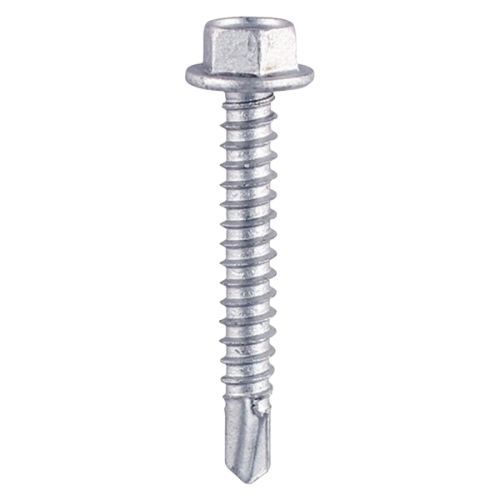
Choosing a head type
• Hex is what most people reach for. You drive it with a nut driver or a tek adapter rather than a bit, so there's less cam-out and more torque available while the point is working.
• Pan Head Phillips is the light-duty option, mostly used fixing to metal framing.
• Countersunk Phillips goes where the head has to finish flush with the surface.
• Hex Stitching screws are their own thing. Reduced-diameter point, made for joining sheet to sheet at the laps, supplied with a 16mm bonded washer already on the screw.
Tek screw sizes and drill points
The number on a tek screw's point tells you how much steel it will go through. Higher number, thicker steel. Our range runs on two of them: a No.3 point on the light section screws, a No.5 on the heavy.
| Range |
Drill point |
Drills into |
| Hex Head Tek Light |
No.3 |
Steel up to 5mm, coarse thread |
| Hex Head Tek Heavy |
No.5 |
Steel up to 12mm, fine thread |
| Hex Head Stitching |
Reduced diameter |
Thin sheet into thin sheet, 16mm bonded washer already fitted |
| Hex Head Sheet to Timber |
Slash, sometimes called type 17 |
Sheet steel up to 0.8mm, down onto timber |
If you've got a screw in your hand and no idea what point it is, measure the drilling tip. That length is roughly the thickest material it will get through. Err low. If the steel is thicker than the point can clear, the screw jams and the head tears off, and then you're drilling the remains out of a hole you can no longer see.
Tek screws for steel: light section or heavy section
When fixing steel to steel, most orders come down to this one choice.
• Light section screws run a coarse thread and a short drilling point, rated to 5mm of steel. That covers purlins, side rails, light framing, ducting and most sheet-to-steel cladding.
• Heavy section screws run a fine thread and a longer point, rated to 12mm. Structural steel and beam work, plus anything you'd struggle to put a hand drill through.
Caught between the two? Go heavy. A heavy section screw in thin steel drives slower and costs a bit more per hundred. A light section screw in 8mm steel is scrap, and so is the twenty minutes spent getting the broken shank back out.
Tek screws for metal, timber and composite panels
A standard tek screw is a metal-to-metal fastener, that's what the drill point is for. Timber and panel work needs a different screw, and picking by name alone is where people come unstuck.
Metal to wood screws fix thin sheet steel, 0.8mm maximum, down onto timber. They carry a slash point, sometimes called a type 17, which bites in wood instead of skating across it. They don't work in reverse. Fixing timber onto steel takes wood to metal screws.
Composite and insulated panels need length more than they need point strength, and that's what High Thread Heavy Screws are for.
How to use tek screws
1. Pull the two materials you're fixing tight together before you start. Leave a gap and the thread pushes the top sheet away as it bites, so the fixing finishes loose.
2. Use a slow drill speed and steady pressure. The point needs time to cut. Running flat out builds heat and takes the edge off it.
3. We would recommend a nut driver or tek adapter on hex heads. A screwdriver bit will round the head off before the screw seats.
4. Stop when the head meets the surface. Keep going and you'll strip the thread you just cut in the steel, or crush the washer past the point where it seals.
There's more on how they work in our full guide to tek screws, and on the difference between self-drilling and self-tapping screws.